
Measles in 2026: CDC Data and Adult Vaccine Guidelines
- Oluchukwu M. Ezeala

- Jun 5
- 2 min read
The CDC and state health departments continue to update the public on measles cases and outbreaks across the United States. According to CDC data , as of May 28, a total of 1,983 confirmed measles cases have been reported from 40 U.S. jurisdictions, including 9 cases among international visitors. Most cases occurred among children aged 5–19 years (51%), followed by adults aged 20 years or older (28%), and children under 5 years (21%). States such as South Carolina (669 cases), Utah (484 cases), Texas (182 cases), and Florida (139 cases) currently bear the greatest burden. In addition, 30 new outbreaks have been reported in 2026. Of the 1,983 confirmed cases, 1,847 (93%) have been associated with outbreaks with 517 linked to outbreaks that began in 2026 and 1,330 linked to outbreaks that started in 2025.
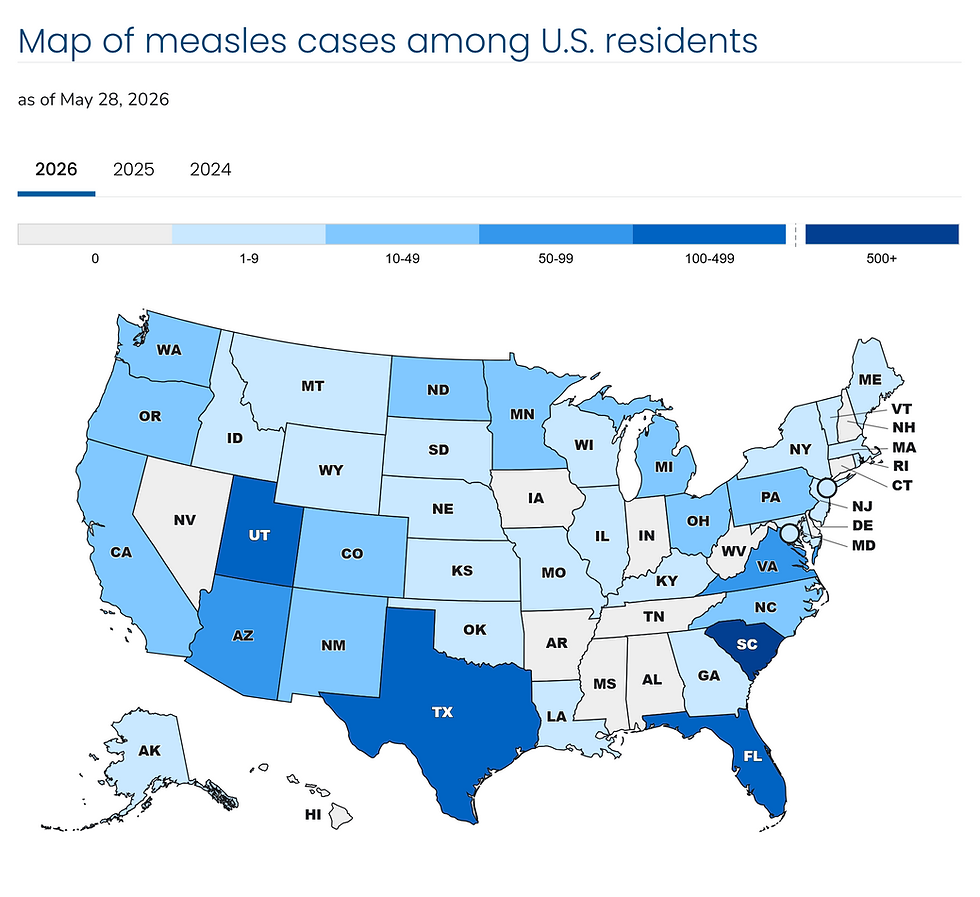
Although no cases have been reported in Alabama, travel for business, school, and tourism increases the risk of exposure. Therefore, vaccination, particularly among older adults who may have waning immunity, remains an important prevention strategy that should be considered. CDC vaccination recommendations for non-pregnant adults vary depending on whether they were born before or after 1957.
For adults born before 1957:
• Individuals who are not healthcare personnel do not need to be vaccinated.
• Healthcare personnel who lack evidence of immunity or prior measles vaccination should consider receiving two doses of the MMR vaccine, particularly during outbreaks.
• Healthcare personnel with acceptable evidence of immunity do not need to be vaccinated.
For adults born in 1957 or later:
• Individuals who are not healthcare personnel, international travelers, post-secondary education students, immunocompromised persons, or close contacts of immunocompromised persons and do not have documentation of receiving either one dose of a measles-containing vaccine or laboratory evidence of immunity should receive one dose of the MMR vaccine.
• Individuals who belong to one or more of these groups and do not have evidence of immunity or complete vaccination should receive one or two doses of MMR, depending on whether they have previously received one dose or no doses, respectively.
• Individuals with acceptable evidence of immunity do not need to be vaccinated, whether or not they belong to one of the groups listed above.
See the full adult measles vaccination guide for additional details.


Comments